


Caption: Street scene in Victoria's Chinatown, 1886.

When gold was discovered in 1858, British Columbia experienced its first large wave of Chinese immigrants. Many Chinese workers had already been working in the California gold rush, and there was a need for workers in B.C. to help build roads, clear land, and develop new communities. Most Chinese immigrants travelled north from California and arrived in Victoria, where they established Canada’s first Chinatown that same year.
(Image D-04737 courtesy of BC Archives)
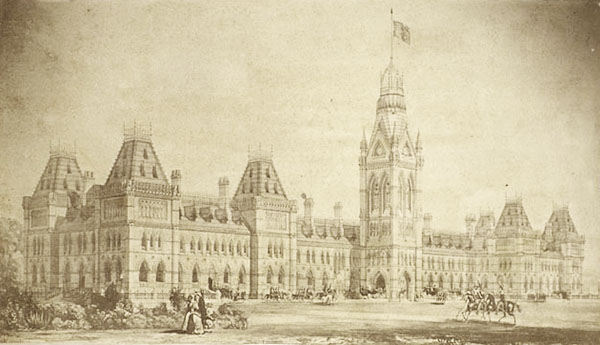
Caption: Canadian Parliament buildings circa 1870.


The Canadian Government wanted more settlers in the west to stop the United States from expanding north. They created the Immigration Act, opening offices in the United Kingdom and promising safe travel to people who wanted to move to Canada. Immigrants from Europe were preferred, but people of all backgrounds could come.
(Image Acc. No. 1970-190-4 courtesy of Library and Archives Canada)

Caption: Chinese workers at camp, circa 1886.
Royal Engineer and early Abbotsford settler Alben Hawkins wrote in his diary of a “Chinemen [sic] Camp” just up the river, where he sold two of his pigs. This shows that there was already an established Chinese community in the area as early as 1878.
(Image D-04712 courtesy of BC Archives)
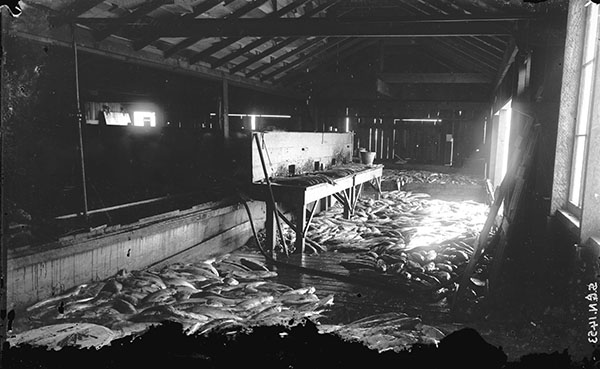
Caption: Interior of a Salmon Cannery, 1890s.

Starting in the 1880s, settlers began opening canneries on the Fraser River. These canneries caught and packed fish to be sold around the world. Many Stó:lō families found work at the canneries, with men doing the fishing and women and older children processing the salmon. Japanese and Chinese labourers were also employed to process fish at the canneries. Work was segregated by race and supervised by white management.
(Image SGN 1453 courtesy of City of Vancouver Archives)

Caption: Chinese arch on Store Street in Victoria, 1882.
As the Chinese population grew, Chinatowns were built across British Columbia and became important centres for community life. Two developed in Chilliwack, and a large “Chinatown” also formed in Mission, although it was mostly made up of Japanese immigrants. In Abbotsford, there was no clear central Chinese neighbourhood. Only small pieces of evidence remain, such as a few Chinese farmers, a bunkhouse for Chinese workers at the Abbotsford Lumber Company, and a Chinese laundry in Clayburn that served local residents.
Many Chinese residents were not fully recorded in official documents like census records. Most Chinese labourers were paid workers rather than landowners, which means their history was often not well recorded or has been partly lost over time.
(Image A-02846 courtesy of BC Archives)

Caption: CPR labourers at camp in Kamloops, 1886.
Thousands of Chinese immigrants worked on building the Canadian Pacific Railway (CPR), which connected British Columbia to the rest of Canada. They were paid about half as much as white workers and were often given the most dangerous jobs. Their labour helped reduce construction costs by an estimated $3–5 million. Between 600 and 2,200 Chinese workers are believed to have died from accidents, explosions, rockslides, drowning, poor nutrition, and disease, although no official records were kept.
(Image D-04713 courtesy of BC Archives)

Caption: Head tax certificate for Lee Sing Dok, 1913.
In 1885, the federal government introduced a “head tax” of $50 on all Chinese immigrants in an effort to discourage more Chinese people from coming to Canada. The tax was raised to $100 in 1900 and then to $500 in 1903, which was equal to more than two years of wages for the average Chinese labourer. Chinese immigrants were the only nationality ever required to pay a special entry tax to come to Canada.
(Record from Volume [RG76] 712 courtesy of Library and Archives Canada)
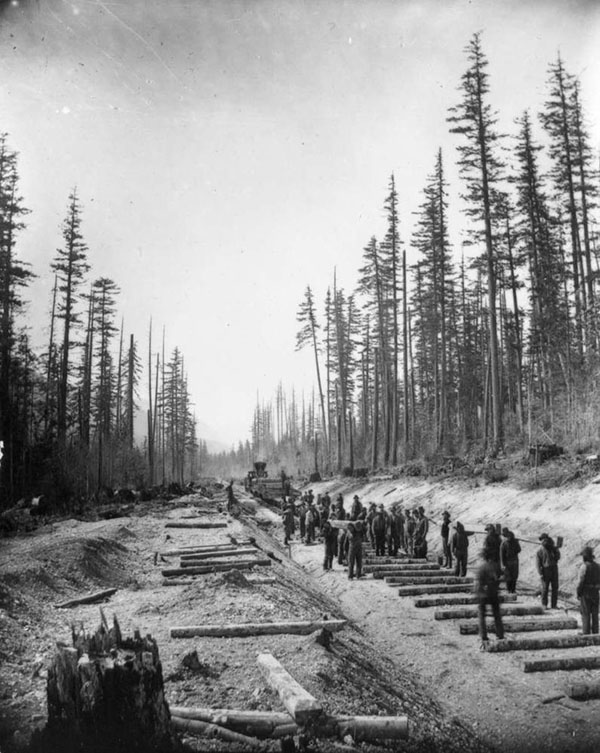
Caption: Men laying railway ties through the Fraser Valley, circa 1881–1883.
The Canadian Pacific Railway (CPR) began running through the Fraser Valley. Travel became much easier, and many European settlers moved into Stó:lō Temexw. Many of the Chinese immigrants who had helped build it moved to cities and towns to find work. Some settled in growing communities along the railway. Many opened restaurants, stores, or laundry businesses, while others became farmers. Employers started hiring Chinese workers for low pay in jobs that Stó:lō people used to do. This was unfair because it took advantage of Chinese workers and lowered wages for Stó:lō workers.
(Image A-07021 courtesy of BC Archives)

Caption: Mission as seen from the Matsqui side of the Fraser River, 1909.
After severe flooding in 1882 showed that the river dykes were not strong enough, the Matsqui Lands Company hired hundreds of Chinese immigrants to rebuild and strengthen the flood protection system. Many of these workers had recently arrived after helping build the newly completed Canadian Pacific Railway (CPR).
(Image B-07889 courtesy of BC Archives)
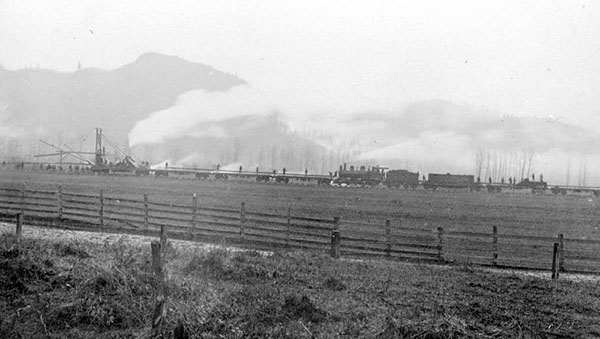
Caption: Train travels through Matsqui Prairie, circa 1912.
In 1889, an additional Canadian Pacific Railway line from Mission to the U.S. border was built. John Cunningham Maclure, a former Royal Engineer, pre-empted the land that would become downtown Abbotsford because he knew it was the best spot to build the railway. The station built there was named “Abbotsford” after Harry Abbot, a CPR superintendent.
(Image E-00487 courtesy of BC Archives)
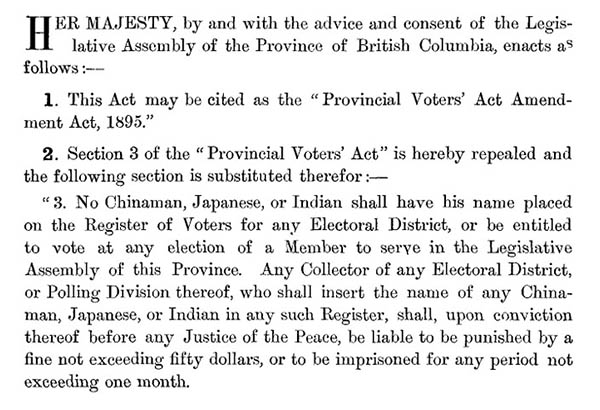
Caption: Excerpt from the Provincial Voter's Act of 1895.
Japanese and Chinese Canadians were no longer allowed to vote in local, provincial, or federal elections. This rule lasted into the 1940s. Only a small number of Japanese Canadian soldiers from the First World War were allowed limited voting rights. The 1895 amendment to the Provincial Voters' Act also banned Indigenous people from voting in Provincial elections (in addition to the federal voting ban introduced by the Indian Act in 1876).
(Image courtesy of BC Laws at gov.bc.ca)
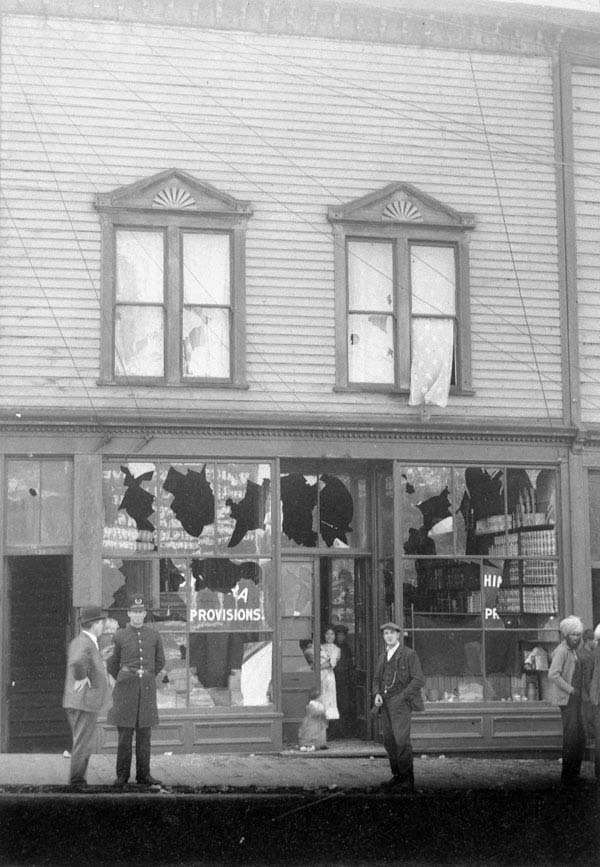
Caption: Damage done by rioters to a Japanese Canadian business in Vancouver, 1907.
Anti-Asian riots broke out in Vancouver because some people claimed that Chinese and Japanese workers, especially men, were taking jobs from white workers. To get away from the violence many Japanese Canadians moved east to the Fraser Valley. Because of public pressure, the federal government made a deal with Japan called the “Gentlemen’s Agreement.” It limited immigration to only 400 adult men per year, which stopped most Japanese people from coming to Canada. However, women and children were still allowed to immigrate.
(Image C-014118 courtesy of Library and Archives Canada)
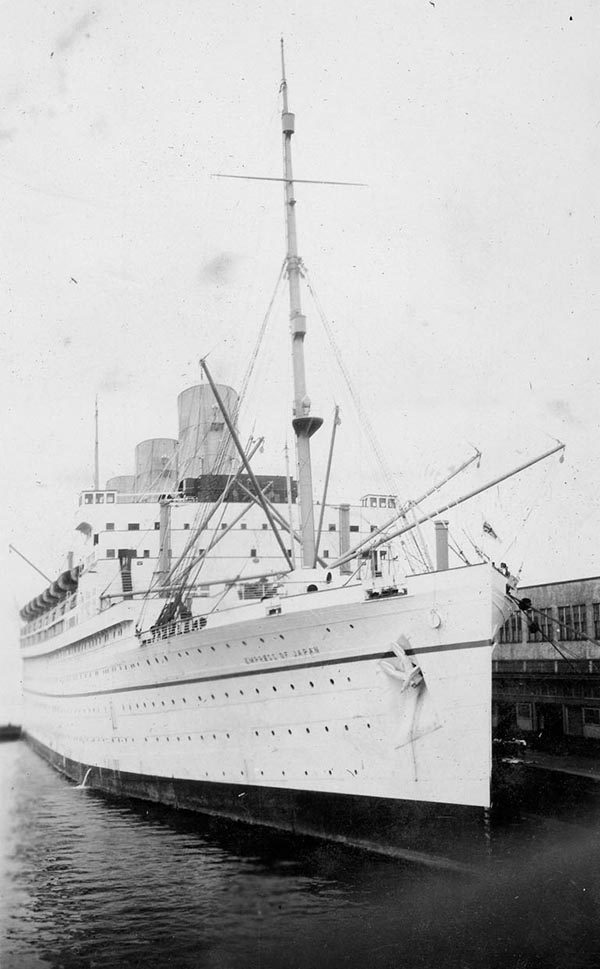
Caption: The RMS Empress of Japan at dock.
Canada passed the Continuous Journey Regulation, which said immigrants had to travel to Canada in one trip without stopping. This made it very hard for Asian immigrants, whose ships needed to stop along the way.
(Image 2014.14.2.2.104 courtesy of the Nikkei National Museum & Cultural Centre)
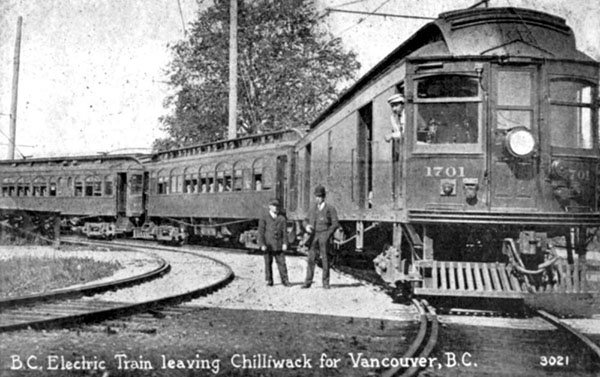
Caption: BCER Train on the Chilliwack-Vancouver line, 1910s.

Many new railways were built in Abbotsford, such as the Great Northern Railway, the Canadian National Railway, and the B.C. Electric Railway. These railways helped the lumber and dairy industries grow because they could now ship products quickly to cities like Vancouver. The Mill Lake lumber mill became one of the area’s most important businesses.
(Image E-00487 courtesy of BC Archives)

Caption: Anti-Asian cartoon from the BC Saturday Sunset, August 10, 1907.
Because the First World War sent many working-aged men to fight in the military, employers in British Columbia and other provinces suggested bringing in more Chinese workers to fill job shortages. At the same time, hostility toward Chinese workers increased in the years that followed. Racist articles often appeared in newspapers such as the ASMN (Abbotsford, Matsqui, Sumas News) and the Abbotsford Post. Many people feared that Chinese workers, who were paid less and seen as very efficient, would take jobs away from white European workers.
(Image 39047 courtesy of the Vancouver Public Library)
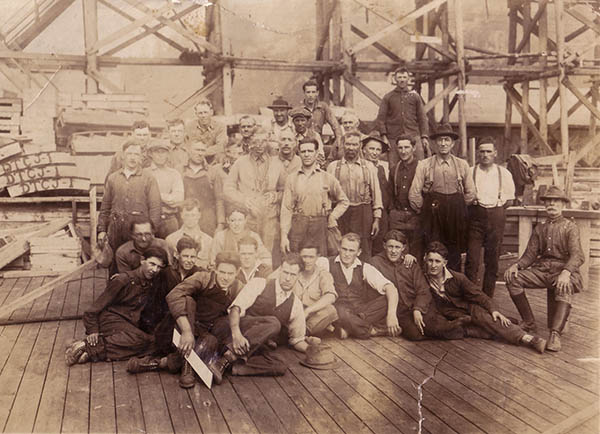
Caption: Millworkers from the Abbotsford Lumber, Mining, & Development Company, circa 1920s.
The lumber mill on Mill Lake upgraded by adding new machines. By this time about 150 workers of South Asian, Japanese, Chinese, and European backgrounds worked at the mill.

Caption: Chinese sawmill workers in New Westminster, circa 1920.
The Chinese Labour Association was formed in 1916 in British Columbia. Within just two years, it had more than 500 members. Together, they worked to push for better working conditions, fair treatment, and equal pay. At the time, the average Chinese worker still earned about half as much as white workers doing similar jobs.
(Image IHP8536 courtesy of New Westminster Archives)

Caption: Municipal Act Amendment Act text, 1919.
A new law was introduced in 1919, prohibiting Chinese-owned or run businesses from employing white women and girls, under the guise of protecting their safety. The law, which was justified by racist beliefs that Chinese men posed a moral and sexual danger to white women, stated: "No person shall in any municipality employ in any capacity any white woman or girl or permit any white woman or girl to reside or lodge in or to work in or […] to frequent any restaurant, laundry, or place of business or amusement owned, kept, or managed by any Chinese person.”
(Image courtesy of BC Laws)
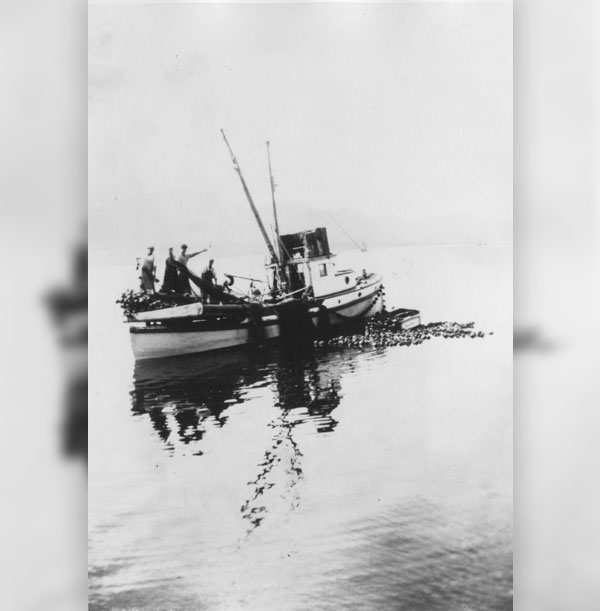
Caption: Japanese Canadian fishermen work on a fishing trawler.
After many years of low salmon returns, the Government banned all fishing on the Fraser River. Many Stó:lō people had to get other work picking berries, fruit, and other cash crops in Mission.
(Image 2001.04.138 courtesy of the Nikkei National Museum & Cultural Centre)

Caption: Newspaper clipping from the Chilliwack Progress, November 29, 1921.
Between 1921 and 1934, several fires, believed to be arson, destroyed much of Chilliwack’s two Chinatowns and led to the deaths of some residents. During the same time, the Ku Klux Klan held demonstrations in Abbotsford and spread fear about Chinese immigrants, claiming they were a threat to white workers. These events helped force many Chinese residents to leave and led to the decline of the local Chinese community.
(Article from the Chilliwack Progress courtesy of Chilliwack's Chinatowns: A Story of Diversity, Racism, and Arson)

Caption: Text of the 1923 Chinese Immigration Act.
The Chinese head tax was finally removed, but it was quickly replaced by an even stricter law. The new law, called the Chinese Immigration Act, effectively stopped Chinese immigration to Canada. At the same time, all people of Chinese descent living in Canada, including those born in the country, had to register with the government or face fines, jail, or deportation. This law stopped families from reuniting, slowed the growth of communities, and increased social and economic inequality.
(Image courtesy of the Museum of Canadian Immigration at Pier 21 and Library and Archives Canada)
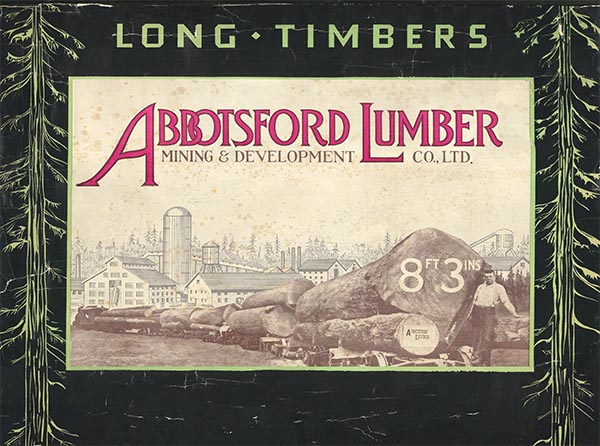
Caption: Advertisement for the Abbotsford Lumber Mining & Development Company, circa 1919 to 1928.
The lumber mill on Mill Lake expanded, and business was strong. In 1924, the mill closed for six weeks to upgrade its machines so it could process even more lumber. That year was a record year, with 275 workers and millions of feet of lumber produced.
(Image 85.41.1099 from Heritage Abbotsford Society)
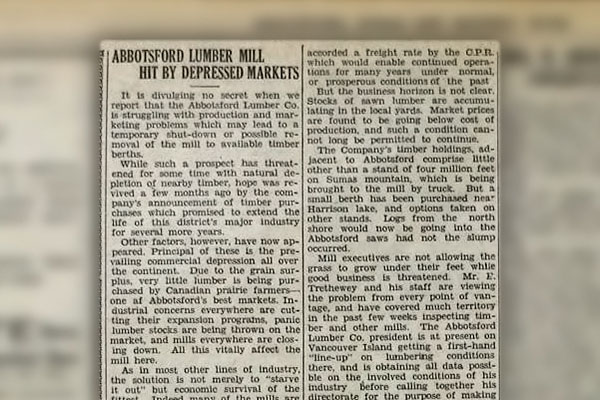
Caption: Article about the Abbotsford Lumber Company from the ASM News, circa 1930.
By 1928, the Abbotsford Lumber Company was in decline. Most of the nearby trees had already been cut, and the Great Depression made lumber less in demand. Because of pressure from locals and fewer jobs, the company fired 40–50 workers who were of South Asian, Chinese, and Japanese backgrounds—a racist layoff meant to keep jobs for white European workers. By the mid-1930s, the Abbotsford mill closed, logging stopped, and the company switched to selling products in stores instead.
(Image courtesy of the Abbotsford, Sumas and Matsqui News Archive)
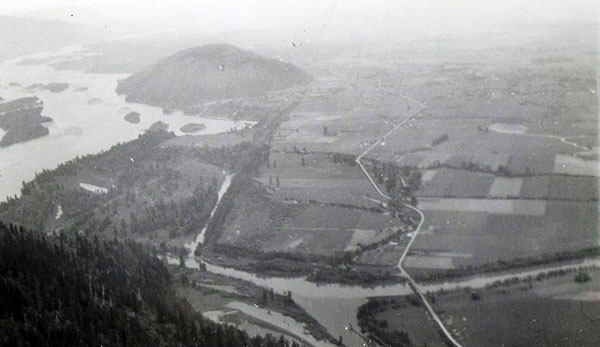
Caption: Aerial view from Sumas Mountain showing the Interprovincial highway running east to west over the Vedder Canal, circa 1940s.
In 1931, the first part of the Trans-Canada Highway in the Fraser Valley opened on Sumas Prairie. By 1941, the route from Clearbrook to Vancouver was complete. Trucking companies—mostly owned by white settlers at first—began moving goods by road. This made the railways less important to the local economy.
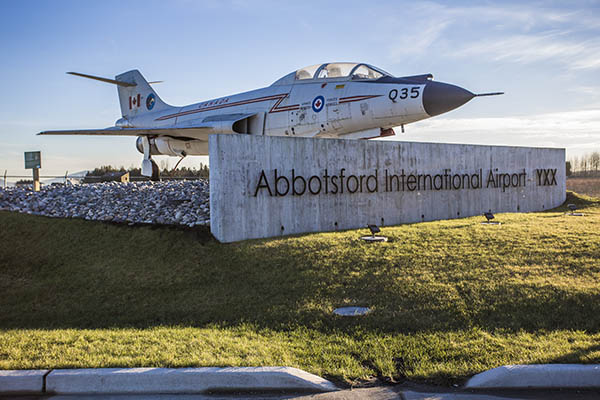
Caption: Entrance to the Abbotsford International Airport.
During World War II, an airport was built in Abbotsford to help defend the west coast. It opened on July 14, 1943, and became Canada’s biggest military airport, with more than forty buildings. The Royal Canadian Air Force Station closed in 1945, and the airport became civilian-run in 1958. In 1997, the City of Abbotsford bought it from the federal government, and it still operates today as Abbotsford International Airport.
(Image by YXXOps, CC BY-SA 4.0, via Wikimedia Commons)

Caption: Quote from Prime Minister Stephen Harper's speech apologizing for the Exclusion Act on behalf of the Canadian Government in 2006.
The Chinese Exclusion Act (officially the Chinese Immigration Act, 1923) was repealed by the Canadian government on May 14, 1947. This gave Chinese Canadians the right to vote and allowed some immigration to begin again. However, other unfair laws against Asian immigrants were still in place.
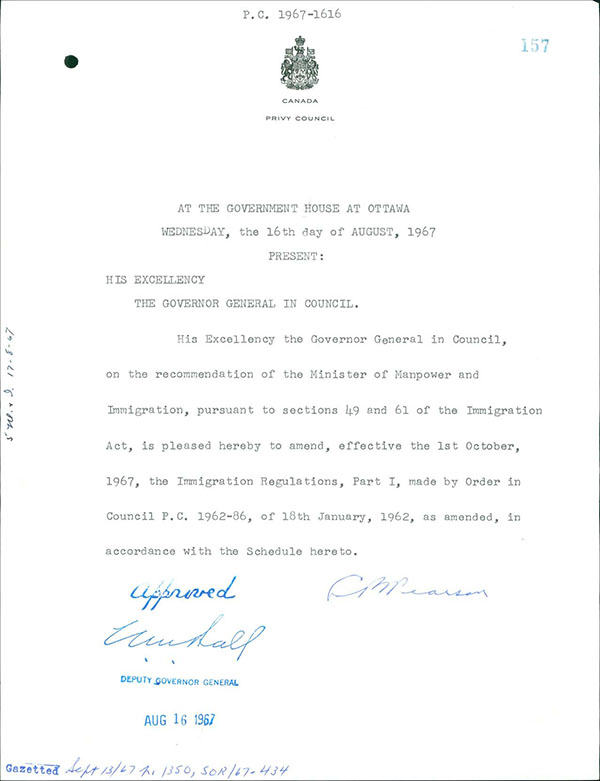
Caption: Order in Council amending immigration policy, 1967.

In 1962, Canada ended its system that set limits based on a person’s country of origin. In 1967, a new point system was created to decide who could immigrate, attempting to make Canada’s immigration rules fairer and less racist. However, the points system gave preference to workers with skills and education, instead of farmers and labourers who came from less privileged backgrounds.
("Immigration Act, Immigration Regulations, Part 1, Amended" courtesy of Library and Archives Canada via the Canadian Museum of Immigration at Pier 21)