


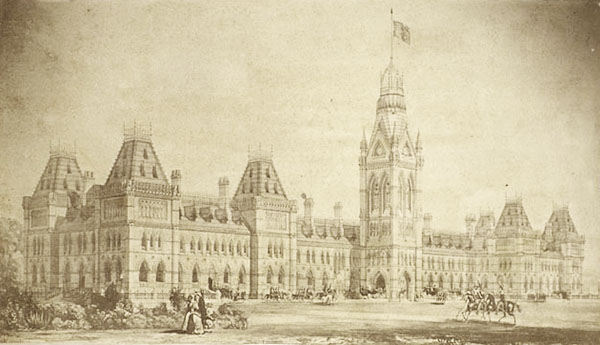
Caption: Canadian Parliament buildings circa 1870.


The Canadian Government wanted more settlers in the west to stop the United States from expanding north. They created the Immigration Act, opening offices in the United Kingdom and promising safe travel to people who wanted to move to Canada. Immigrants from Europe were preferred, but people of all backgrounds could come.
(Image Acc. No. 1970-190-4 courtesy of Library and Archives Canada)
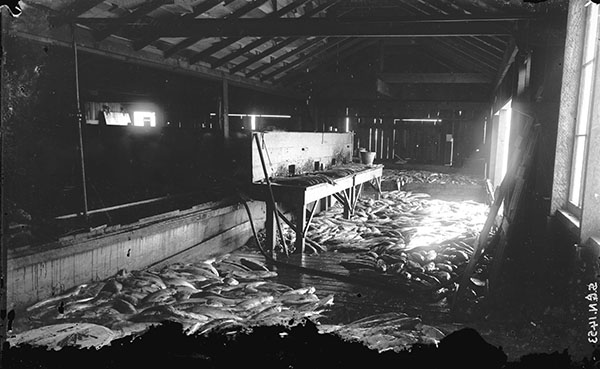
Caption: Interior of a Salmon Cannery, 1890s.

Starting in the 1880s, settlers began opening canneries on the Fraser River. These canneries caught and packed fish to be sold around the world. Many Stó:lō families found work at the canneries, with men doing the fishing and women and older children processing the salmon. Japanese and Chinese labourers were also employed to process fish at the canneries. Work was segregated by race and supervised by white management.
(Image SGN 1453 courtesy of City of Vancouver Archives)

Caption: Chinese arch on Store Street in Victoria, 1882.
As the Chinese population grew, Chinatowns were built across British Columbia and became important centres for community life. Two developed in Chilliwack, and a large “Chinatown” also formed in Mission, although it was mostly made up of Japanese immigrants. In Abbotsford, there was no clear central Chinese neighbourhood. Only small pieces of evidence remain, such as a few Chinese farmers, a bunkhouse for Chinese workers at the Abbotsford Lumber Company, and a Chinese laundry in Clayburn that served local residents.
Many Chinese residents were not fully recorded in official documents like census records. Most Chinese labourers were paid workers rather than landowners, which means their history was often not well recorded or has been partly lost over time.
(Image A-02846 courtesy of BC Archives)
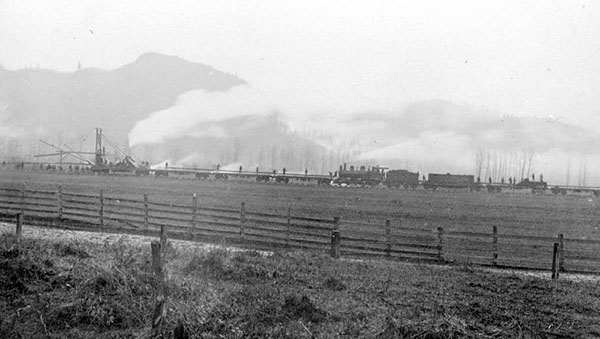
Caption: Train travels through Matsqui Prairie, circa 1912.
In 1889, an additional Canadian Pacific Railway line from Mission to the U.S. border was built. John Cunningham Maclure, a former Royal Engineer, pre-empted the land that would become downtown Abbotsford because he knew it was the best spot to build the railway. The station built there was named “Abbotsford” after Harry Abbot, a CPR superintendent.
(Image E-00487 courtesy of BC Archives)
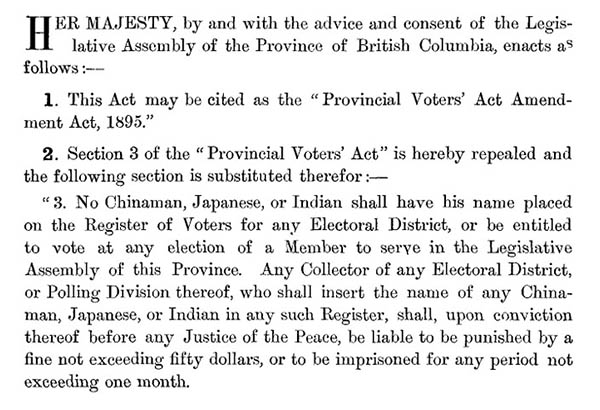
Caption: Excerpt from the Provincial Voter's Act of 1895.
Japanese and Chinese Canadians were no longer allowed to vote in local, provincial, or federal elections. This rule lasted into the 1940s. Only a small number of Japanese Canadian soldiers from the First World War were allowed limited voting rights. The 1895 amendment to the Provincial Voters' Act also banned Indigenous people from voting in Provincial elections (in addition to the federal voting ban introduced by the Indian Act in 1876).
(Image courtesy of BC Laws at gov.bc.ca)
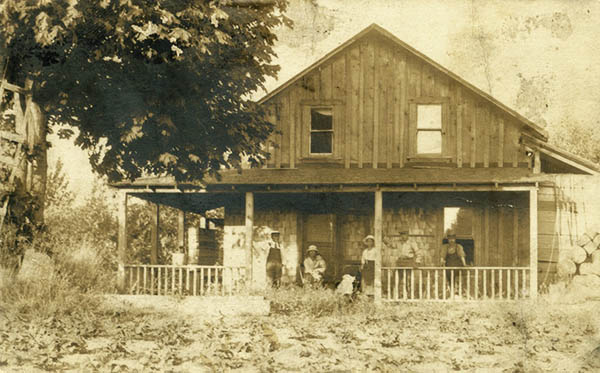
Caption: Yamamoto family and their house at Mt. Lehman, circa 1925.
The first Japanese settler to arrive in Abbotsford, Kiyu Ogata, moved to Mount Lehman. Over the next 30 years, more than seventy Issei (first generation Japanese immigrants) families followed. They were drawn to Stó:lō territory by the prospect of independent farming. They cleared land, grew crops, and helped build the Fraser Valley’s early berry farming industry.
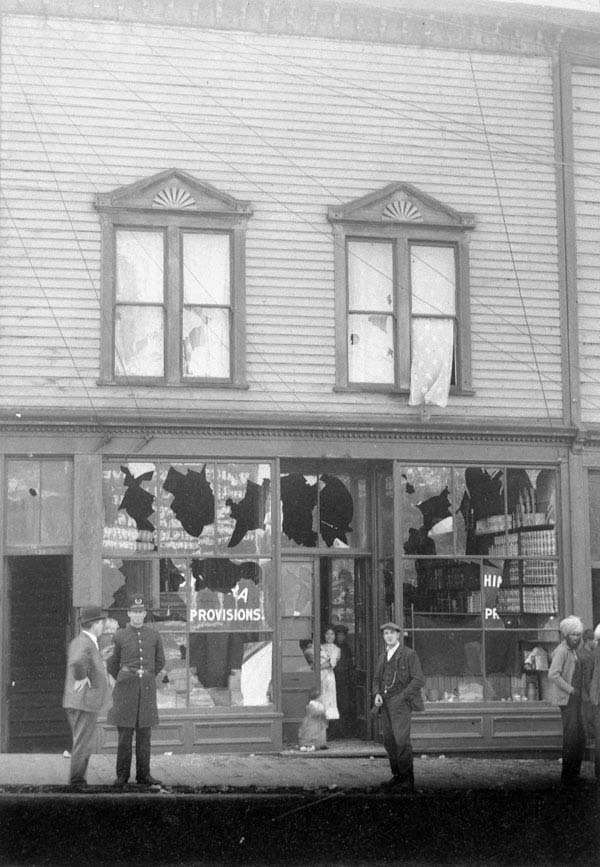
Caption: Damage done by rioters to a Japanese Canadian business in Vancouver, 1907.
Anti-Asian riots broke out in Vancouver because some people claimed that Chinese and Japanese workers, especially men, were taking jobs from white workers. To get away from the violence many Japanese Canadians moved east to the Fraser Valley. Because of public pressure, the federal government made a deal with Japan called the “Gentlemen’s Agreement.” It limited immigration to only 400 adult men per year, which stopped most Japanese people from coming to Canada. However, women and children were still allowed to immigrate.
(Image C-014118 courtesy of Library and Archives Canada)
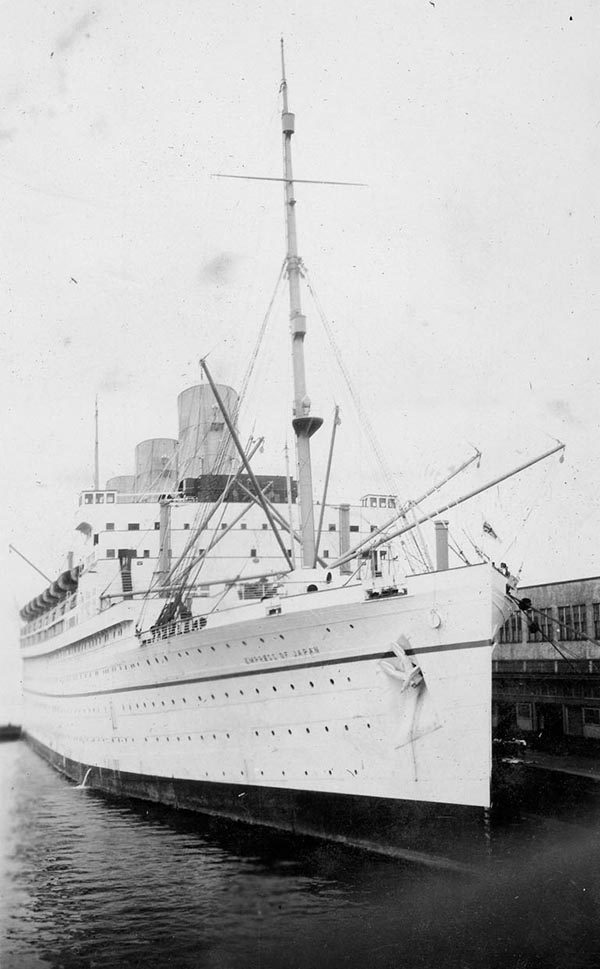
Caption: The RMS Empress of Japan at dock.
Canada passed the Continuous Journey Regulation, which said immigrants had to travel to Canada in one trip without stopping. This made it very hard for Asian immigrants, whose ships needed to stop along the way.
(Image 2014.14.2.2.104 courtesy of the Nikkei National Museum & Cultural Centre)
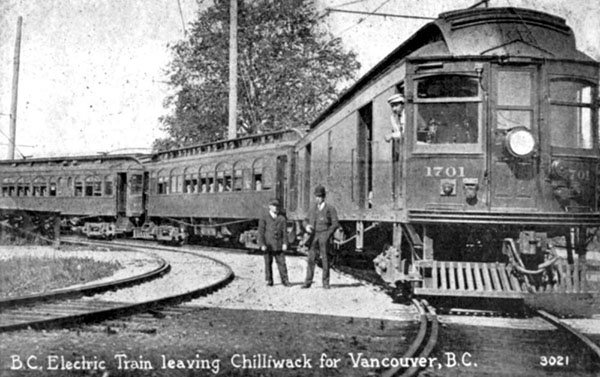
Caption: BCER Train on the Chilliwack-Vancouver line, 1910s.

Many new railways were built in Abbotsford, such as the Great Northern Railway, the Canadian National Railway, and the B.C. Electric Railway. These railways helped the lumber and dairy industries grow because they could now ship products quickly to cities like Vancouver. The Mill Lake lumber mill became one of the area’s most important businesses.
(Image E-00487 courtesy of BC Archives)
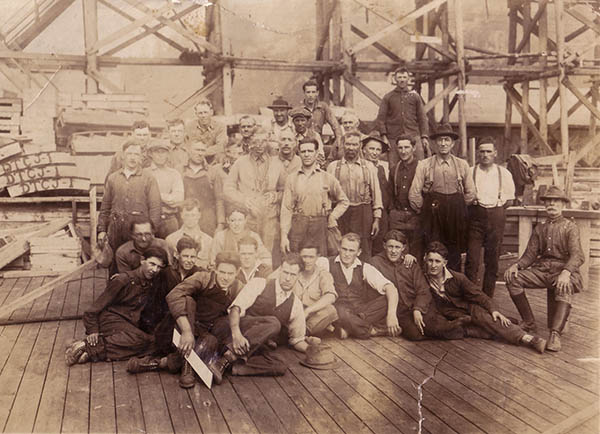
Caption: Millworkers from the Abbotsford Lumber, Mining, & Development Company, circa 1920s.
The lumber mill on Mill Lake upgraded by adding new machines. By this time about 150 workers of South Asian, Japanese, Chinese, and European backgrounds worked at the mill.
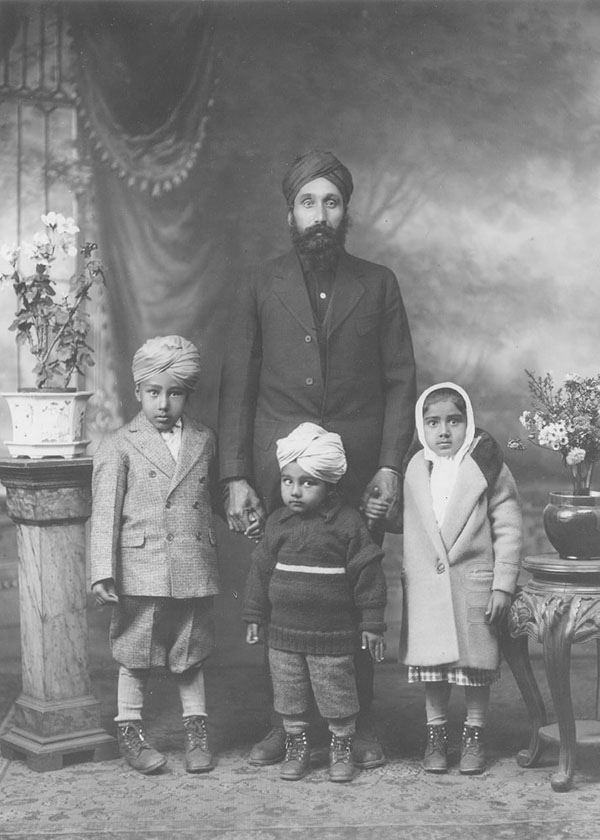
Caption: Abbotsford's Giani Naranjan Singh Thauli with three of his children.
The Canadian government changed the rules so Asian immigrants could apply to bring their wives and children to Canada. Before this, many men in Abbotsford worked for years without seeing their families. Even after the rule change, it often took a long time for families to reunite.
(Image 2005-033-001 courtesy of Delta Museum and Archives)
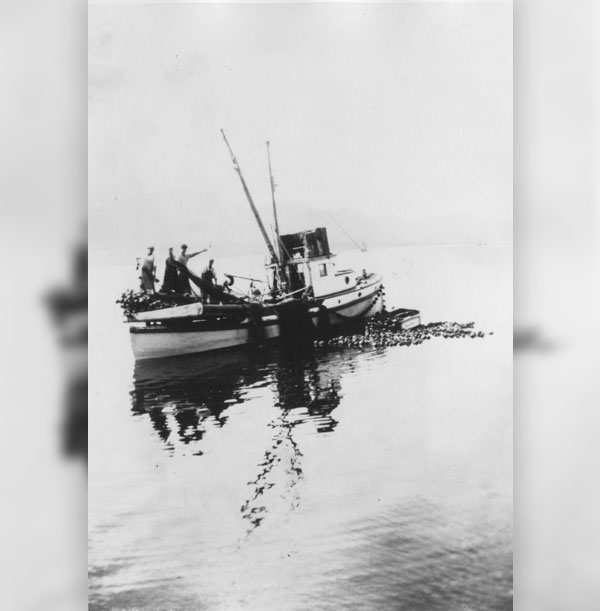
Caption: Japanese Canadian fishermen work on a fishing trawler.
After many years of low salmon returns, the Government banned all fishing on the Fraser River. Many Stó:lō people had to get other work picking berries, fruit, and other cash crops in Mission.
(Image 2001.04.138 courtesy of the Nikkei National Museum & Cultural Centre)
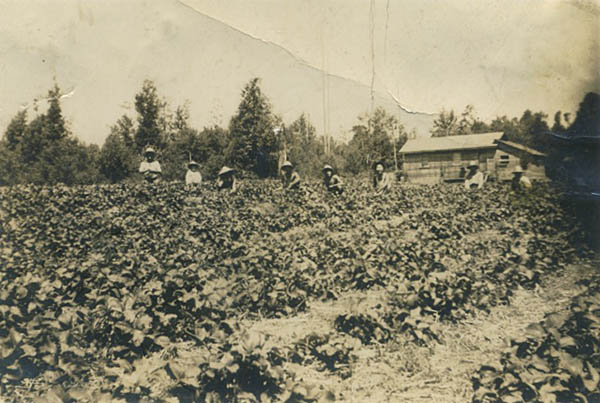
Caption: Pickers harvest berries at the Saito family farm.
Living mostly on his own in the Clayburn area, Riichi Sasaki built up his farm without the support that other Japanese Canadian communities had. In 1920, he returned from Japan with his new wife, Misako. He cleared several acres of land and built their home. Together, they became the first family to grow strawberries in Clayburn. Strawberries later became an important crop for many Japanese Canadian farmers in the Fraser Valley. The Sasakis brought their early berry harvests to Mission by horse and cart along rough, bumpy trails.
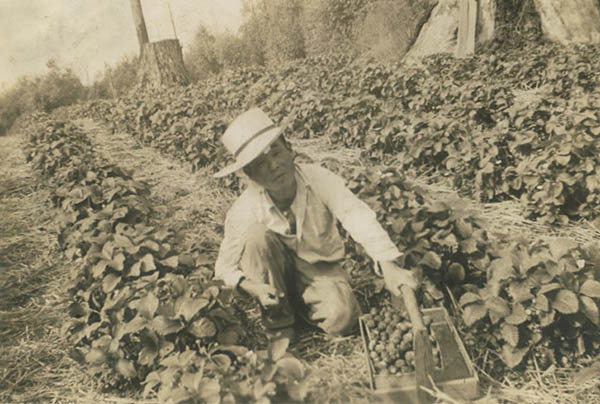
Caption: Tominosuke Saito picks strawberries in Matsqui.
Farming was already an appealing choice for Japanese Canadians, but more people turned to it because racist government rules pushed them out of other jobs. In the 1920s, the government gave far fewer fishing licences to Japanese Canadian fishermen, and many lost their jobs. Many of these workers moved to the Fraser Valley, where Japanese Canadian farming communities were already established and helped them get started as berry farmers.
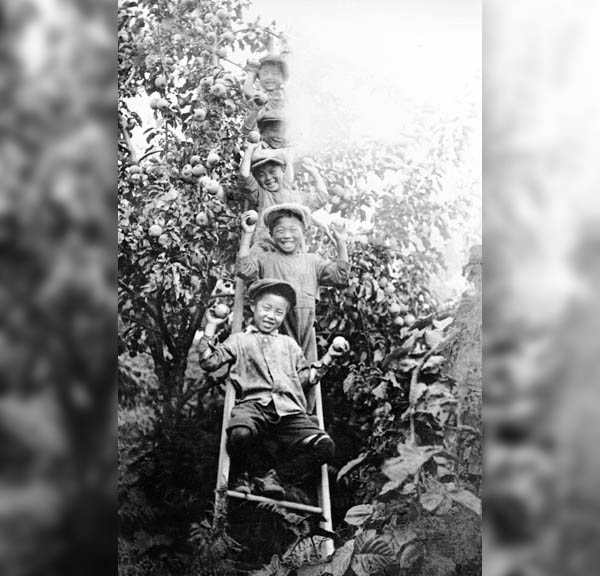
Caption: Boys in Mission BC proudly display their pickings, circa 1926.
In Mission, Issei farmer Bunjiro Sakon created new types of crops, like autumn strawberries and winter rhubarb. These crops could grow for much longer than usual, so farmers in the Fraser Valley, including Abbotsford, could keep harvesting and earning money for more months of the year. Local farming associations called Nokai worked together, taking turns growing different crops. This helped make sure there were enough crops for everyone to sell and that all families could earn a steady living.
(Image 2010.23.2.4.700 courtesy of the Nikkei National Museum & Cultural Centre)
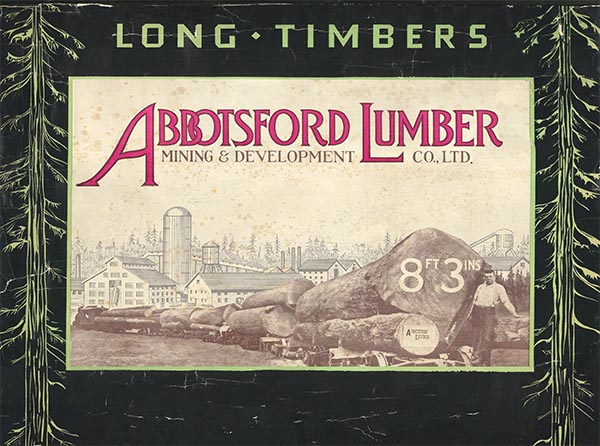
Caption: Advertisement for the Abbotsford Lumber Mining & Development Company, circa 1919 to 1928.
The lumber mill on Mill Lake expanded, and business was strong. In 1924, the mill closed for six weeks to upgrade its machines so it could process even more lumber. That year was a record year, with 275 workers and millions of feet of lumber produced.
(Image 85.41.1099 from Heritage Abbotsford Society)

Caption: Anti-Asian immigration cartoon printed in the Saturday Sunset, August 24, 1907.
Under pressure from B.C. politicians and anti-Asian racists, Canada asked Japan to limit immigration even further. The new agreement allowed only 150 people per year, including women and children. In order to bring in skilled workers under these strict rules, Japanese Canadian communities together chose candidates, often from their home villages, and asked the Japanese consulate to approve them. Sponsored workers had to stay on the farms that sponsored them for at least three years.
(Image 39046 courtesy of the Vancouver Public Library)
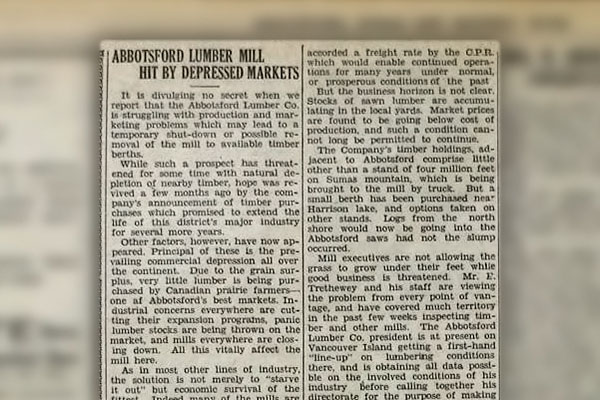
Caption: Article about the Abbotsford Lumber Company from the ASM News, circa 1930.
By 1928, the Abbotsford Lumber Company was in decline. Most of the nearby trees had already been cut, and the Great Depression made lumber less in demand. Because of pressure from locals and fewer jobs, the company fired 40–50 workers who were of South Asian, Chinese, and Japanese backgrounds—a racist layoff meant to keep jobs for white European workers. By the mid-1930s, the Abbotsford mill closed, logging stopped, and the company switched to selling products in stores instead.
(Image courtesy of the Abbotsford, Sumas and Matsqui News Archive)
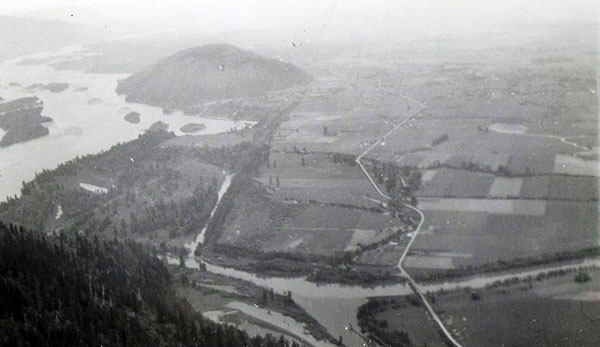
Caption: Aerial view from Sumas Mountain showing the Interprovincial highway running east to west over the Vedder Canal, circa 1940s.
In 1931, the first part of the Trans-Canada Highway in the Fraser Valley opened on Sumas Prairie. By 1941, the route from Clearbrook to Vancouver was complete. Trucking companies—mostly owned by white settlers at first—began moving goods by road. This made the railways less important to the local economy.
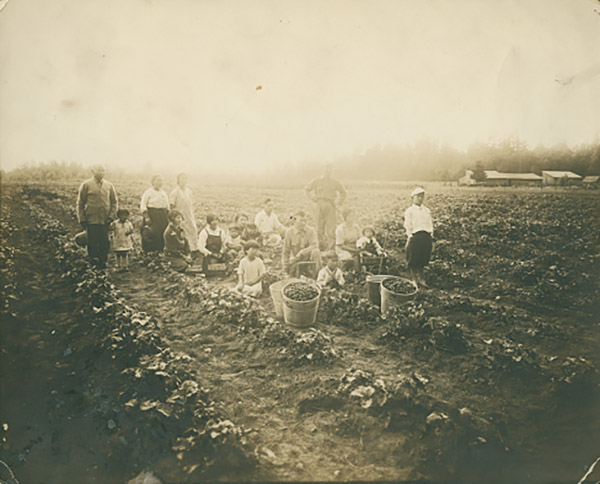
Caption: The Haraga Family's Strawberry Farm in Abbotsford prior to 1927.
By 1934, Japanese Canadian farmers owned 63% of the Fraser Valley’s farmland. Their careful and hardworking way of farming made them very successful in growing small fruits. At the time, a government inspector estimated that over 85% of the berries in the Fraser Valley came from their farms. This number probably grew even more in the years before the war.
(Image 2001.28.2.8.3 courtesy of the Nikkei National Museum & Cultural Centre)
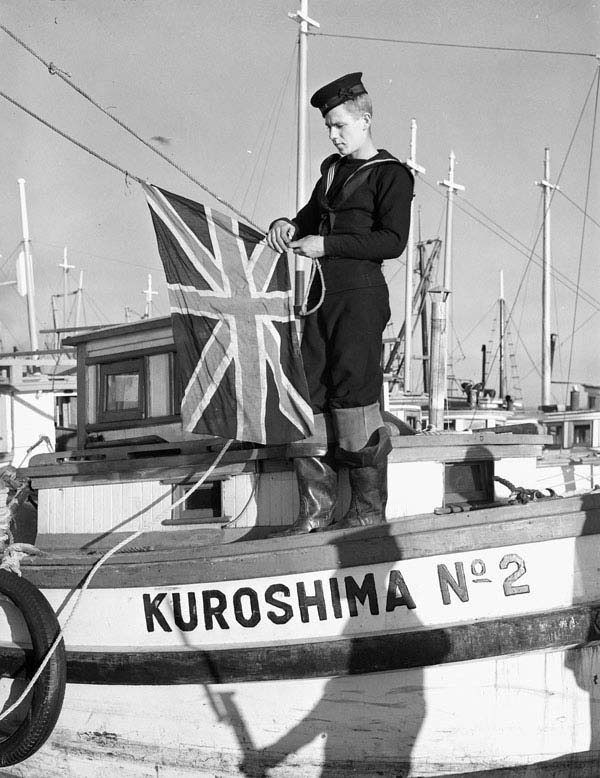
Caption: Sailor attaches a British flag to a seized Japanese Canadian fishing boat, 1941.
On December 7, Japan attacked Pearl Harbor. Canada quickly declared war on Japan, which made long-standing racism against Japanese Canadians in British Columbia worse. People became even angrier after Hong Kong fell and news spread about Japanese attacks on Canadian soldiers. Fears grew as Japan advanced quickly across the Pacific. The morning after the attack, the Canadian government began targeting Japanese Canadians. They took away fishing boats, closed Japanese-language newspapers, and told the police to arrest people they believed to be a threat.
(Image PA-170513 courtesy of Library and Archives Canada)
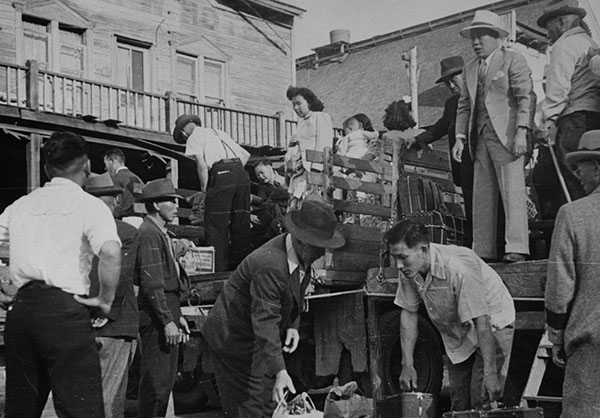
Caption: Japanese Canadians taken from the coast of BC arrive at an internment camp in Slocan, 1942.
The War Measures Act was put into effect, making coastal British Columbia a “protected area.” The government forcibly removed Japanese Canadians from the Fraser Valley, even those who were born in Canada. Families were separated—some were sent to internment camps, while others were sent to farms in the B.C. interior, Alberta, or Manitoba. The Japanese Canadian communities in Abbotsford were destroyed in just a few weeks, and by 1944, the local berry farming industry had completely collapsed.
(Image C-047396 courtesy of Library and Archives Canada)
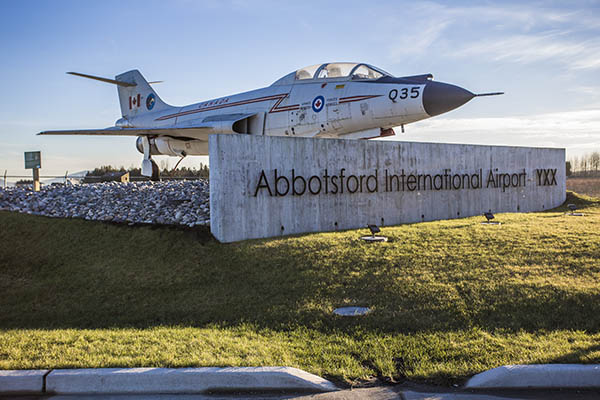
Caption: Entrance to the Abbotsford International Airport.
During World War II, an airport was built in Abbotsford to help defend the west coast. It opened on July 14, 1943, and became Canada’s biggest military airport, with more than forty buildings. The Royal Canadian Air Force Station closed in 1945, and the airport became civilian-run in 1958. In 1997, the City of Abbotsford bought it from the federal government, and it still operates today as Abbotsford International Airport.
(Image by YXXOps, CC BY-SA 4.0, via Wikimedia Commons)

Caption: A farmhouse in Bradner in 1949, a neighbourhood where many Japanese Canadian families lived prior to internment.
In 1943, the Canadian government sold property that had been taken from Japanese Canadians at the start of internment in an effort to help cover the cost of their mass incarceration. Mennonites, who in many cases had more working-age men remaining at home during the war, were often among the buyers of these farms in the Lower Mainland. The advantage in buying well-established farms helped some Mennonite families benefit from the post-war economic boom, since there was less competition for land and farming opportunities.
(Image CA CMBS NP198-2-2 courtesy of Centre for Mennonite Brethren Studies, via the Mennonite Archival Information Database)
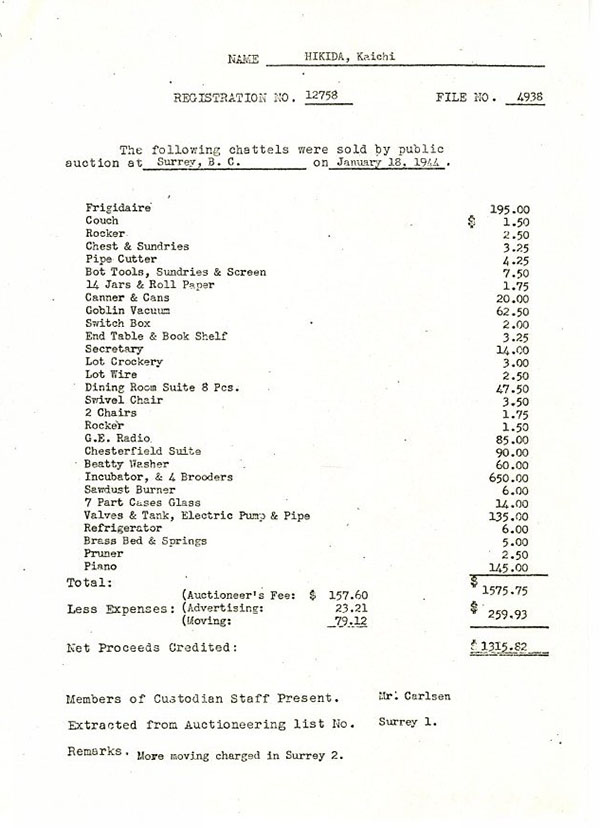
Caption: List of Kaichi Hikida's property put up for public auction after being seized by the Government during internment.
After the war, restrictions on Japanese Canadians were lifted, but very few came back to the Fraser Valley. Almost 4,000 had been sent to Japan, even though many had never lived there. Those who stayed in Canada had nothing to return to. Their belongings had been sold at auctions, and their homes and land had been sold, mostly to returning war veterans through the Veteran Lands Act.
(Image 2018.16.1.40.45 courtesy of the Nikkei National Museum & Cultural Centre)
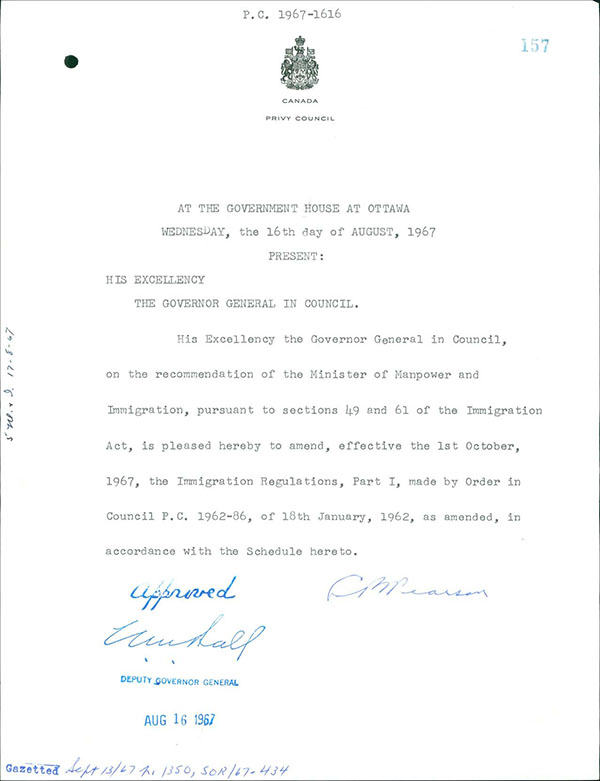
Caption: Order in Council amending immigration policy, 1967.

In 1962, Canada ended its system that set limits based on a person’s country of origin. In 1967, a new point system was created to decide who could immigrate, attempting to make Canada’s immigration rules fairer and less racist. However, the points system gave preference to workers with skills and education, instead of farmers and labourers who came from less privileged backgrounds.
("Immigration Act, Immigration Regulations, Part 1, Amended" courtesy of Library and Archives Canada via the Canadian Museum of Immigration at Pier 21)