


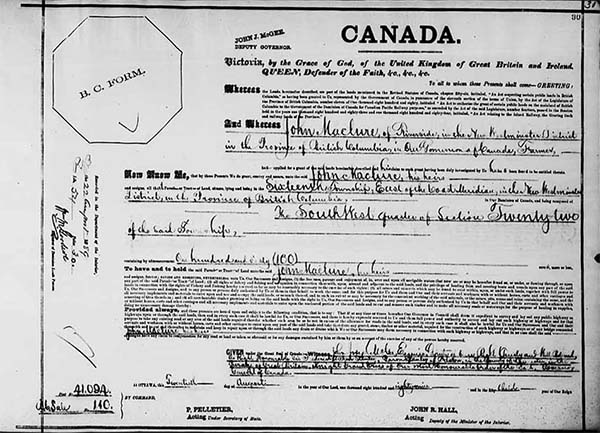
Caption: Western Land Grant in the Name of John Maclure, 1889.


In 1872, the Dominion Lands Act launched the Dominion Lands Survey, a massive project which helped map out the western provinces. It allowed male settlers over the age of 21 to claim 65 hectares of land for $10. This encouraged more European settlers to move west.
(Image courtesy of Library and Archives Canada)

Caption: Mennonite farmhouse and stable in Winkler, Manitoba. Many Mennonite families started out on the Prairies before moving to communities in BC.
Feeling their way of life was being threatened under the Russian Empire, the first Mennonites began moving to Canada in the 1870s. At the same time, to prevent Americans from expanding into Canada, the Canadian government wanted more people to settle in the west. To encourage more Mennonites to move to Western Canada, the government promised them freedom of religion and exemption from military service. Most settled on the Prairies, but by 1901 some Mennonites had also moved to the Fraser Valley. By the 1911 census, 191 Mennonites were living here.
(Image PA-018151 courtesy of Library and Archives Canada)
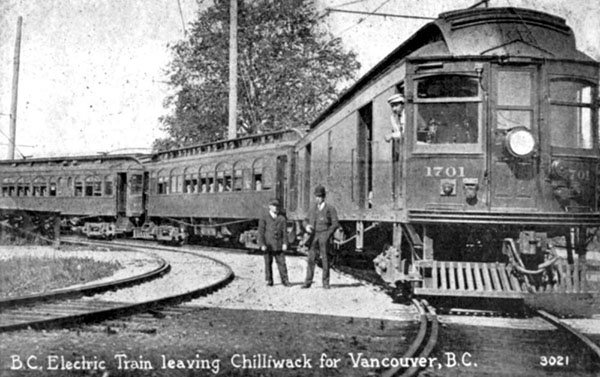
Caption: BCER Train on the Chilliwack-Vancouver line, 1910s.


Many new railways were built in Abbotsford, such as the Great Northern Railway, the Canadian National Railway, and the B.C. Electric Railway. These railways helped the lumber and dairy industries grow because they could now ship products quickly to cities like Vancouver. The Mill Lake lumber mill became one of the area’s most important businesses.
(Image E-00487 courtesy of BC Archives)

Caption: A Mennonite collective farm in the Soviet Union after the Russian Revolution.
The hardship of the First World War led to the collapse of the Russian monarchy, followed by the Bolshevik Revolution and the Russian Civil War. As violence and instability grew, many Mennonite families decided to leave. Many moved to Canada, where they joined Mennonite communities on the Prairies and the Fraser Valley in search of safety and a better future.
(Image CA MHC 715-39.0 courtesy of Mennonite Heritage Archives, via the Mennonite Archival Information Database)

Caption: Article about Mennonite migration in the Abbotsford, Sumas and Matsqui News from 1943.
In 1927, Fraser Valley settlers Eckert and Crain began advertising 10-acre farms in Yarrow to Mennonite families in Winnipeg. This led to the first two families arriving in December 1927, with larger groups following in 1928. Many Mennonites worked picking hops on Sumas Prairie to earn money while they started their own farms.
While many British settlers viewed Mennonites as hardworking and honest, there was still some tension. The Abbotsford Sumas Matsqui newspaper published negative articles about large numbers of Mennonites moving to the area, which created fears that British settlers might be pushed out or replaced.
(Image courtesy of the Abbotsford, Sumas and Matsqui News Archive)

Caption: Dueck Building Supplies Ltd. in Clearbrook, 1961.
Mennonite settlement in the Fraser Valley continued to grow. Most Mennonites were farmers who settled in close-knit Mennonite villages, such as Yarrow. They took part in important farming industries like dairy, tobacco, and hops, and they also became well known for growing raspberries. Clearbrook was cleared for farming and developed into a centre for Mennonite-owned businesses, including farm supply stores, grocery stores, and credit unions.
(Image CA MAO XV-19.3-1992-14-3117 courtesy of Mennonite Archives of Ontario, via the Mennonite Archival Information Database)
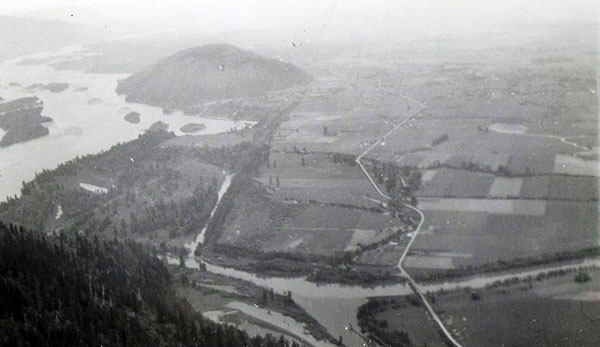
Caption: Aerial view from Sumas Mountain showing the Interprovincial highway running east to west over the Vedder Canal, circa 1940s.
In 1931, the first part of the Trans-Canada Highway in the Fraser Valley opened on Sumas Prairie. By 1941, the route from Clearbrook to Vancouver was complete. Trucking companies—mostly owned by white settlers at first—began moving goods by road. This made the railways less important to the local economy.

Caption: South Abbotsford Church, 1943.
The outbreak of World War II led to a rise in anti-German feelings, which affected local Mennonites who spoke German. They also faced hostility because, due to their religious belief in pacifism, they refused to fight as soldiers.
Even so, Mennonite migration continued during the war because of the disruption caused in Europe. The Village of Arnold was founded as another Mennonite farming community, giving settlers a place where they could live and farm together and feel somewhat protected from local prejudice. Mennonite churches began to be built across the region, and the community founded schools such as the Mennonite Educational Institute (MEI) and Bethel Bible Institute (now Columbia Bible Institute) to educate their children.
(Image CVA 1184-212 courtesy of City of Vancouver Archives)

Caption: Picker hauls hops on Sumas Prairie, circa 1940.
Mennonites went on strike in the hop fields, hoping to raise the wage to 5 cents per pound for picking hops. However, the strike was not successful. Hop farmers were able to take advantage of divisions between different groups of workers and continued hiring other settlers and Indigenous workers for 3 cents per pound. This marked the beginning of the decline of Mennonite involvement in hop farming.

Caption: Entrance to the Abbotsford International Airport.
During World War II, an airport was built in Abbotsford to help defend the west coast. It opened on July 14, 1943, and became Canada’s biggest military airport, with more than forty buildings. The Royal Canadian Air Force Station closed in 1945, and the airport became civilian-run in 1958. In 1997, the City of Abbotsford bought it from the federal government, and it still operates today as Abbotsford International Airport.
(Image by YXXOps, CC BY-SA 4.0, via Wikimedia Commons)

Caption: A farmhouse in Bradner in 1949, a neighbourhood where many Japanese Canadian families lived prior to internment.
In 1943, the Canadian government sold property that had been taken from Japanese Canadians at the start of internment in an effort to help cover the cost of their mass incarceration. Mennonites, who in many cases had more working-age men remaining at home during the war, were often among the buyers of these farms in the Lower Mainland. The advantage in buying well-established farms helped some Mennonite families benefit from the post-war economic boom, since there was less competition for land and farming opportunities.
(Image CA CMBS NP198-2-2 courtesy of Centre for Mennonite Brethren Studies, via the Mennonite Archival Information Database)

Caption: Large group of young Mennonite women who participated in the Mädchenheim system in Vancouver, 1940s.
During the post-war economic boom, young Mennonite men usually worked on their family farms, but also took on additional work as truckers, construction workers, and sawmill workers. Young unmarried women also helped at home, but many moved to Vancouver through the Mädchenheim system to work as maids for wealthy European families. They also did seasonal farm work, such as picking berries. These young workers used their savings to start their own farms and businesses once they were ready to get married and have children of their own.
(Image CA CMBS NP045-01-44 courtesy of Centre for Mennonite Brethren Studies, via the Mennonite Archival Information Database)

Caption: Aron and Olga Rempel pick raspberries on their farm in Yarrow.
The Abbotsford Growers Co-operative Union was founded by Mennonite farmers based on the model of the Japanese Canadian Cooperative in Mission. This allowed raspberry growers to pool resources for washing and processing. The union has continues to operate today and has expanded beyond it's original Mennonite roots to include farmers from other backgrounds, and is now largely made up of South Asian growers.
(Image CA MHSBC 199-5-2021.106.006 courtesy of Mennonite Historical Society of British Columbia, via Mennonite Archival Information Database)

Caption: Couple wades through floodwaters at the intersection of Riverside and Clayburn Roads, 1948.
The Fraser River overflowed its banks, causing major flooding on Matsqui Prairie. Mennonite farmers lost their berry crops,and problems with pests and low European imports made the local berry industry temporarily collapse. In response, many Mennonite farmers switched to dairy or poultry farming, or started local businesses to make up for their losses. Some also sold their farms to South Asian families, who are now the majority of berry farmers in Abbotsford today.

Caption: Mennonite students attend South Poplar school, 1943.
As Mennonites built up their economic life in Abbotsford, many encouraged their children to pursue higher education and attend university. Over time, these educated children became more integrated into wider society, began speaking English as their first language, and moved into professional careers such as pastors, nurses, doctors, and teachers.
Most Mennonites in Abbotsford became less separated from the wider English-speaking community, although strong cultural and religious connections have continued to keep them closely linked into the 21st century. Many local farm businesses are still operated by well-known Mennonite families today.
(Image CVA 1184-214 courtesy of City of Vancouver Archives)
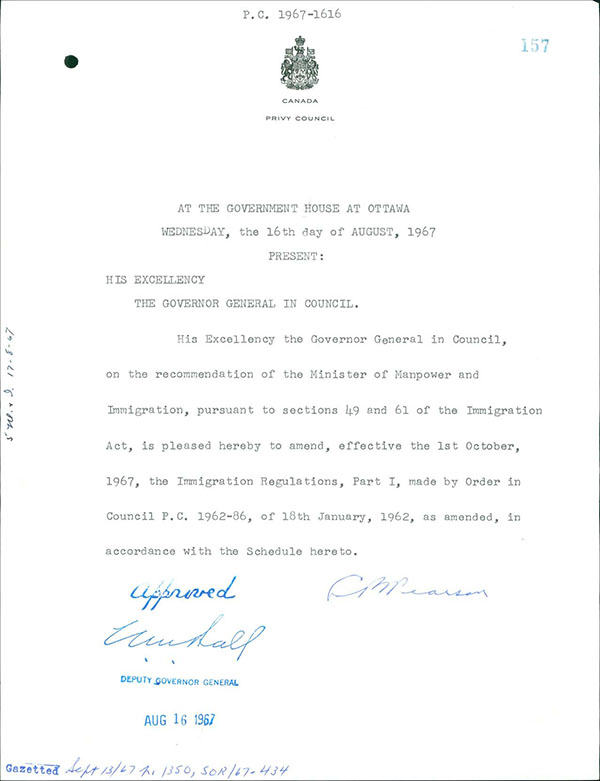
Caption: Order in Council amending immigration policy, 1967.

In 1962, Canada ended its system that set limits based on a person’s country of origin. In 1967, a new point system was created to decide who could immigrate, attempting to make Canada’s immigration rules fairer and less racist. However, the points system gave preference to workers with skills and education, instead of farmers and labourers who came from less privileged backgrounds.
("Immigration Act, Immigration Regulations, Part 1, Amended" courtesy of Library and Archives Canada via the Canadian Museum of Immigration at Pier 21)