


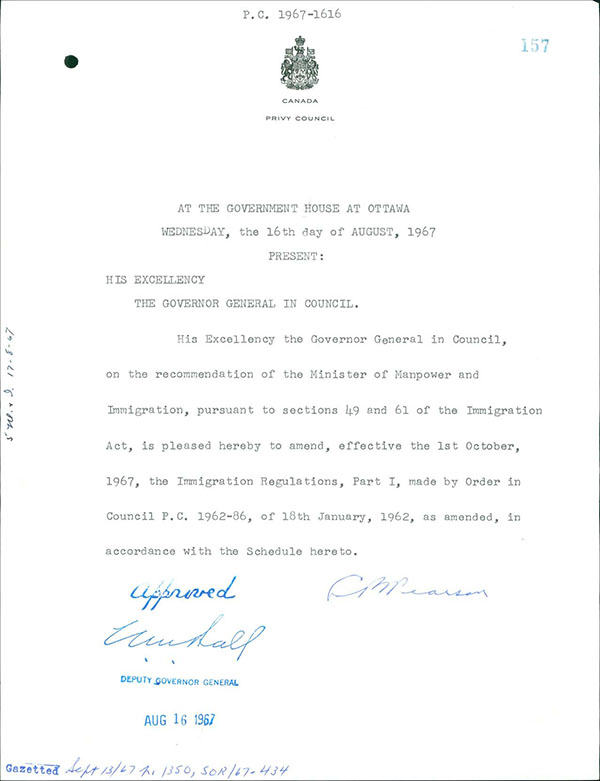
Caption: Order in Council amending immigration policy, 1967.


In 1962, Canada ended its system that set limits based on a person’s country of origin. In 1967, a new point system was created to decide who could immigrate, attempting to make Canada’s immigration rules fairer and less racist. However, the points system gave preference to workers with skills and education, instead of farmers and labourers who came from less privileged backgrounds.
("Immigration Act, Immigration Regulations, Part 1, Amended" courtesy of Library and Archives Canada via the Canadian Museum of Immigration at Pier 21)

Caption: Grain field in Abbotsford, 1949.
In 1966, 264 Jamaican men were allowed into Canada to work seasonally on fruit and vegetable farms in southwestern Ontario. This was the start of what became the Seasonal Agricultural Workers Program (SAWP). This program, which was later brought to British Columbia, allowed farms to bring in workers for short periods to fill labour shortages, even if those workers wouldn’t be allowed come to Canada permanently under the new immigration laws.
(Image CVA 586-106 courtesy of City of Vancouver Archives)
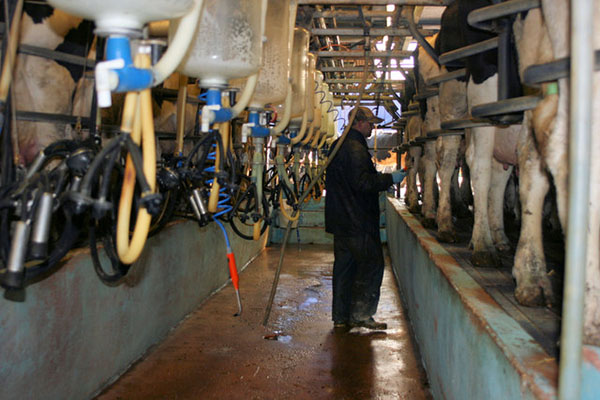
Caption: Farmer runs milking machines on a dairy farm.
As local farm workers became harder to find, Canadian farms used programs to bring in migrant workers. The Temporary Foreign Worker Program began in 2002, and the Seasonal Agricultural Workers Program expanded to British Columbia in 2004. Workers were hired on short-term contracts and could only work for one employer, which made it hard for them to refuse unsafe or unfair work conditions. The United Food and Commercial Workers Union (UFCW) argued that this system created a workforce that is vulnerable to exploitation.
(Image by Nick Chipchase, CC BY-SA 2.0, via Wikimedia Commons)

Caption: Migrant workers pick strawberries.
For the first time, more workers came to Canada as temporary foreign workers than as permanent residents. This shift showed that Canada was becoming more dependent on migrant labour as global trade and supply chains became more connected. While programs like the TFWP and SAWP have serious problems, they continue to grow because of the economic demand.

Caption: UCFW representative stands outside a local office.
In 2008, the United Food and Commercial Workers Union (UFCW) was approved to represent 35 migrant workers at a farm in Surrey. This would have been the first union agreement for migrant farm workers in British Columbia. However, the next year only 12 of those workers were asked back to work. The union argued this was punishing the workers for organizing, and the B.C. Labour Relations Board later cancelled the agreement after the employer challenged it. Because migrant workers rely on being invited back each season, many are afraid to join unions in case they are not rehired.
(Image courtesy of Peter Haden via Flickr, CC BY-NC 2.0)

Caption: The BC government announces the recruiter licensing program aimed at protecting Temporary Foreign Workers, 2019.
Researchers and advocacy groups began reporting how migrant farm workers in Canada face growing health and safety risks. Farm work can be dangerous, and workers risk physical injury or illness from exposure to pesticides and fertilizers. Studies show that language barriers, limited transportation, fear of job loss, and a lack of information about health and insurance systems can stop workers from getting medical help or reporting unsafe work.
(Image courtesy of the Province of British Columbia via Flickr, CC BY-NC-ND 2.0)

Caption: Fraser Valley farm with Mt. Baker in the background.
In 2012, the federal government changed Employment Insurance (EI) rules, which limits migrant workers’ equal access to benefits most Canadians enjoy, such as medical leave, unemployment insurance, or parental and maternity leave. Although temporary foreign workers pay EI premiums from every paycheque they earn in Canada, many cannot claim these benefits because their eligibility ends when their work contracts finish. Despite calls to reverse the policy, the government has not changed these rules.
(Image courtesy of the Province of British Columbia via Flickr, CC BY-NC-ND 2.0)

Caption: Workers pick crops during the Covid-19 pandemic.
In 2020, Canada launched the Agri-Food Immigration Pilot, a program connected to the Temporary Foreign Worker Program (TFWP). The program allowed a small number of agricultural and food industry workers a way to gain permanent residency. The COVID-19 pandemic slowed the program’s rollout. Originally planned to end in 2023, it was extended to 2025 to allow more time to evaluate its results.
(Image courtesy of the Province of British Columbia via Flickr, CC BY-NC-ND 2.0)

Caption: Flooding on Sumas Prairie during the floods of 2021.
In November 2021, extreme rainfall caused flooding across the Fraser Valley. Farms, roads, and other infrastructure were badly damaged, with losses in the billions of dollars. Five people and nearly 700,000 farm animals were killed. Many migrant farm workers suddenly lost both their jobs and their housing. Because their work permits tied them to specific employers they couldn’t find other work and had to wait to find out if they would be sent home. Hundreds of workers already struggling under the strain of the COVID-19 pandemic were displaced and relied on limited help from local charities, community organizations, and faith groups.
(Image courtesy of the Province of British Columbia via Flickr, CC BY-NC-ND 2.0)

Caption: Canadian agricultural workers by origin as of 2017.
In 2017, foreign workers made up 16% of agricultural workers, a percentage which only continues to grow. A report from the Royal Bank of Canada (RBC) predicts that by 2033, about 40% of Canadian farmers will have retired, leading to a shortage of about 24,000 farm workers across the country. As fewer young people enter farming and many family farms are sold to larger operations, Canada’s farming industry is becoming more dependent on vulnerable migrant workers to keep farms running.